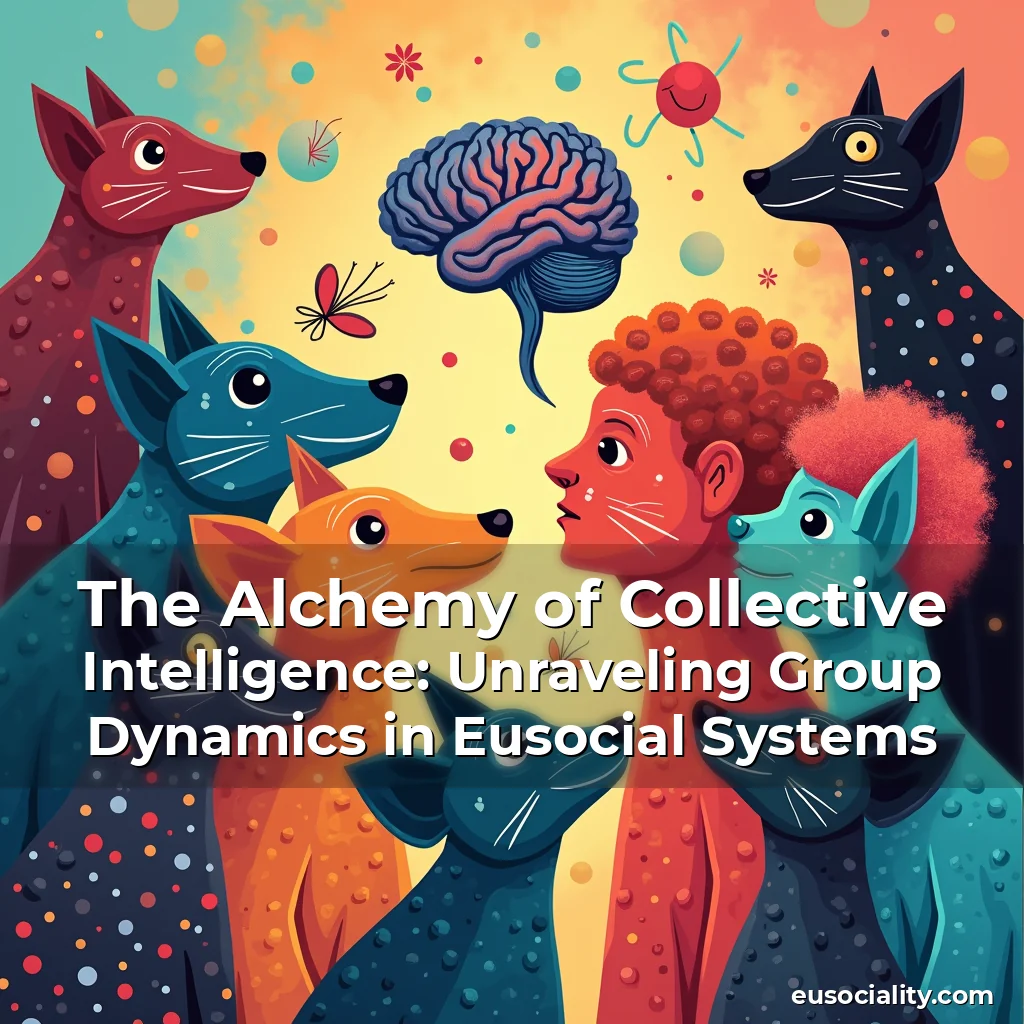
The Alchemy of Collective Intelligence: Unraveling Group Dynamics in Eusocial Systems
In the intricate dance of social organisms, from ants to humans, emerges an extraordinary phenomenon known as group dynamics—the invisible force that binds individuals together into cohesive units capable of achieving feats beyond individual capability. This complex interplay is particularly fascinating within eusocial communities where cooperation transcends mere survival instincts.
Eusocial systems exhibit levels of organization so advanced they rival human societies themselves. Understanding these dynamics not only illuminates our own social structures but also offers profound insights into how highly cooperative groups function across different species.
Fundamental Pillars of Eusocial Group Formation
Eusocial behavior originates from a delicate balance between genetic relatedness and environmental pressures. Insects such as honeybees exemplify this through their division of labor based on age polyethism, where younger workers perform brood care while older ones venture out foraging tasks.
This specialization enhances colony efficiency by ensuring each member contributes optimally according to its physiological state rather than arbitrary assignments. Such structured roles prevent resource wastage and maintain high productivity rates essential for colony sustainability.
- Genetic kinship: Closely related individuals are more inclined to cooperate because helping relatives increases inclusive fitness, thus promoting gene propagation across generations.
- Nest architecture: Physical environments shape interactions; termite mounds with distinct chambers create specialized zones fostering efficient communication and task allocation among castes.
Environmental factors play equally crucial roles. Food scarcity often triggers altruistic behaviors as seen in naked mole-rats forming tight-knit colonies under harsh conditions. These adaptive responses demonstrate nature’s ingenuity in crafting resilient social frameworks.
Despite these foundational principles, exceptions exist—some species display non-genetically driven cooperation suggesting additional layers influence group formation beyond simple evolutionary logic alone.
Dynamics Within Complex Social Hierarchies
Hierarchical structures define many eusocial groups, yet their intricacies vary significantly across species. Honeybee swarms operate democratically during queen selection, whereas ant colonies follow strict caste-based hierarchies determined at birth.
This diversity highlights how leadership models evolve depending on ecological contexts. Democratic processes ensure optimal decision-making when faced with uncertain futures, while rigid casts provide stability amid predictable environments.
Leadership transitions can occur abruptly due to external threats or internal conflicts. When a hive loses its queen, worker bees initiate emergency protocols involving pheromonal signals to locate potential replacements—an example of emergent self-regulation without centralized control.
Such flexibility underscores why certain species thrive despite challenges. It allows rapid adaptation to changing circumstances through collective intelligence manifesting organically within the group itself.
Communication Mechanisms Driving Cohesion
Effective communication lies at the heart of successful group dynamics. Ants use chemical trails left behind by fellow scouts to navigate food sources efficiently—a form of decentralized information sharing enhancing overall group performance.
Beyond biochemical cues, tactile interactions reinforce bonds within colonies. Termites engage in grooming rituals that serve both hygienic purposes and strengthen social ties crucial for maintaining unity amidst daily activities.
Vocalizations and Auditory Signals
Insect societies rely heavily on vibrational sounds produced via stridulation. Grasshoppers communicate through wing friction generating rhythmic pulses used primarily for mate attraction but occasionally signaling danger alerts too.
These auditory mechanisms enable quick dissemination of critical messages across vast distances without requiring direct physical contact. For instance, some cricket species emit warning calls detectable over several meters, prompting nearby conspecifics to flee predators swiftly.
While most insects lack vocal cords, they compensate using body parts modified specifically for sound production. Wing membranes in cicadas vibrate rapidly creating distinctive buzzing noises audible even kilometers away.
This sophisticated system ensures every member receives vital updates simultaneously regardless of location inside dense habitats where visual cues might fail entirely.
Social Learning and Cultural Transmission
Cultural transmission occurs when learned behaviors spread throughout populations much like memes propagate digitally today. Bees learn foraging routes from experienced scouts who mark flowers with scent markers indicating nectar availability.
This knowledge transfer accelerates colony development since new members benefit instantly from accumulated expertise instead of discovering resources independently which would waste time and energy.
Some bird species showcase remarkable cultural traditions passed down through generations. African grey parrots have been observed mimicking human speech patterns accurately after prolonged exposure to spoken language.
Similarly, meerkat sentinels teach young ones about predator recognition by demonstrating alarm calls during actual encounters. Such mentorship ensures critical survival skills get transmitted effectively across lifetimes.
Mechanisms Behind Conflict Resolution Strategies
Conflicts inevitably arise within any group structure, especially those composed of numerous genetically identical individuals competing for limited resources. Worker ants may challenge each other for dominance positions affecting access to preferred tasks.
To mitigate disputes, eusocial species employ various conflict resolution techniques rooted deeply in biological imperatives. Pheromone suppression methods allow subordinate individuals to avoid confrontation by emitting calming chemicals reducing aggressive impulses temporarily.
Physical restraint tactics involve wrapping oneself around aggressors until they cease hostilities—an effective strategy employed frequently among army ants facing intra-colony aggression episodes.
Interestingly, some species resolve conflicts through ritualized displays rather than violence. Male stag beetles engage in elaborate wrestling matches devoid of real harm intent purely to establish hierarchical standings without risking injury.
Evolutionary Advantages of Cooperative Behaviors
Cooperation confers substantial evolutionary benefits enabling species to exploit niches otherwise inaccessible individually. Termite mound construction requires coordinated efforts spanning decades yet yields enduring shelters protecting entire colonies against climatic extremes.
Such long-term investments pay dividends through increased reproductive success rates compared to solitary counterparts unable to sustain similar protective measures economically viable.
Moreover, collective defense strategies enhance security dramatically. Army ant raids overwhelm prey defenses through sheer numbers overwhelming natural resistance capabilities exponentially surpassing lone hunter effectiveness.
Even indirect benefits accrue from collaborative ventures; improved disease resistance develops within tightly knit groups exposed regularly to pathogens forcing continuous immune system upgrades advantageous post-exposure scenarios.
Ecological Impacts of Large-Scale Societies
Larger eusocial aggregations exert significant influences shaping local ecosystems profoundly altering nutrient cycles and vegetation growth patterns. Leafcutter ant farms modify soil composition substantially enriching surrounding areas conducive for plant proliferation beneficially impacting broader biodiversity networks.
Conversely, unchecked expansion could lead to ecosystem degradation. Overgrazing by locust swarms devastates agricultural lands causing widespread famine unless controlled naturally through periodic population crashes regulated endogenously within insect life cycles.
Predator-prey relationships become intertwined dynamically adjusting equilibrium points continuously responding to fluctuations caused by shifting demographics within dominant species populations dominating particular regions ecologically.
Thus, understanding these ripple effects becomes imperative for conservationists aiming to preserve fragile habitats threatened by invasive social species encroaching upon native flora/fauna balances delicately maintained historically before human intervention disrupted established norms.
Redefining Human Societal Structures Through Eusocial Insights
Observing eusocial systems provides fresh perspectives redefining traditional views regarding human organizational paradigms currently prevalent globally. Unlike rigid corporate hierarchies emphasizing top-down directives, insect colonies model fluid role adaptations mirroring agile startup cultures thriving nowadays amidst technological disruptions.
Modern workplaces increasingly adopt swarm intelligence principles optimizing project management workflows akin to ant foraging algorithms prioritizing adaptability versus fixed procedures yielding better outcomes consistently measured objectively against conventional benchmarks.
Furthermore, educational institutions draw parallels implementing peer learning methodologies inspired by how scout bees share discovered flower locations enhancing knowledge diffusion exponentially faster than traditional teacher-student dichotomous models previously considered optimal solely based on pedagogical theories formulated centuries ago.
Urban planners now incorporate biophilic design elements reflecting natural clustering tendencies witnessed in termite mounds encouraging spontaneous community formations fostering organic connectivity strengthening social fabrics woven intricately through shared spaces designed intuitively rather than imposed architecturally.
Future Frontiers in Studying Eusocial Interactions
Ongoing research explores neurobiological bases underlying eusocial traits investigating whether specific brain regions correlate strongly with heightened prosocial inclinations observable amongst selected species exhibiting exceptional cooperation capacities exceeding typical expectations set forth initially by evolutionary biologists analyzing comparative anatomy data sets derived mainly from fossil records.
Advancements in bioinformatics permit genome-wide association studies identifying candidate genes potentially responsible for facilitating complex social behaviors detected across diverse taxa including mammals, arthropods, and mollusks expanding scope considerably beyond previous limitations restricting analyses exclusively towards insects traditionally studied extensively owing largely to their abundance making sampling easier relative to vertebrates generally harder to study due to ethical constraints involved handling conscious beings subjected to experimental manipulations requiring careful consideration always prioritizing welfare above scientific curiosity.
Emerging technologies like quantum computing promise breakthroughs simulating massive neural networks replicating multi-agent interactions occurring routinely within eusocial colonies offering unprecedented insight revealing hidden patterns governing emergence properties arising spontaneously from seemingly random microscopic actions accumulating collectively producing macroscopic order phenomena unattainable through analytical approaches constrained inherently by linear thinking paradigms incapable comprehending nonlinear dynamics characteristic features defining living systems fundamentally differing from artificial constructs governed strictly deterministic laws devoid of inherent unpredictability present universally wherever life exists anywhere in cosmos.
Interdisciplinary collaborations bridging fields ranging from sociology to computer science will undoubtedly redefine our comprehension of what constitutes true society eventually leading toward novel classifications distinguishing between merely aggregated collections versus genuinely integrated entities possessing unified identities functioning cohesively pursuing common goals aligned harmoniously irrespective of differences existing necessarily among constituent parts composing whole greater than sum individual components combined additively mathematically calculated simply adding up quantities numerically representing separate units considered independent entities operating autonomously disconnected from others except coincidental intersections occurring randomly statistically insignificant events happening sporadically lacking intentional coordination aimed deliberately designing synchronized movements orchestrated meticulously through prearranged plans executed precisely following prescribed instructions issued authoritatively from central command posts directing subordinates carrying out assigned duties diligently obeying orders unquestioningly without deviation whatsoever ensuring absolute compliance achieved seamlessly smoothly effortlessly.
Conclusion
Group dynamics in eusocial systems reveal a rich tapestry of cooperative behaviors shaped by millennia of evolutionary refinement. From the strategic divisions of labor in ant colonies to the democratic decision-making processes in bee hives, these organisms offer invaluable lessons applicable across disciplines.
By studying these intricate social structures, we gain deeper insights into managing human organizations, improving communication strategies, and fostering resilience in the face of adversity. Embracing the wisdom embedded in eusocial interactions can inspire innovative solutions addressing contemporary global challenges effectively.