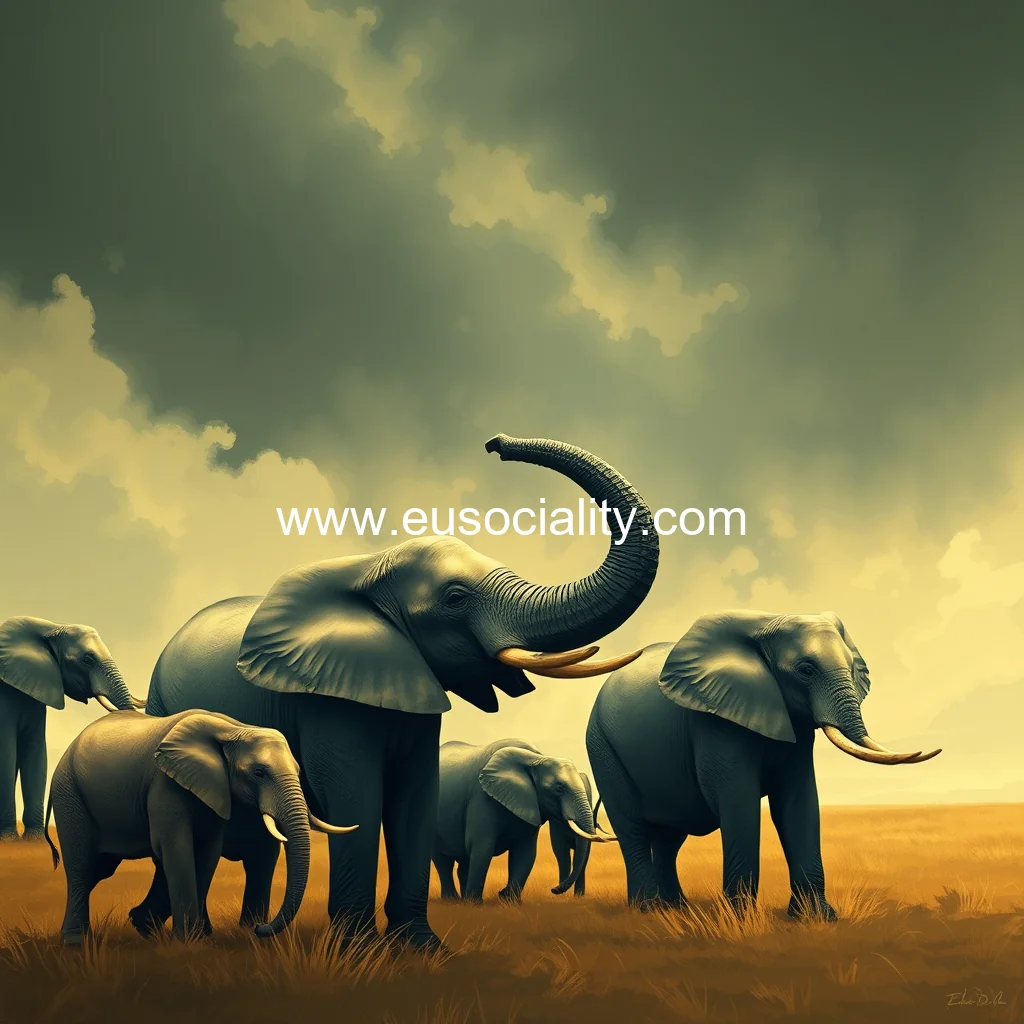
Fragmented landscapes and human disturbance threaten the health and well-being of elephant societies.
The elephants have been living in a fragmented landscape, with limited access to resources and habitat. This has led to a decline in the overall health and well-being of the remaining elephants.
The Impact of Human Disturbance on Elephant Societies
Human disturbance can have a profound impact on elephant societies, leading to a decline in their overall health and well-being. In Vietnam, the decline of the wild elephant population after the wars has resulted in the formation of smaller, fragmented groups. These groups face numerous challenges, including limited access to resources and habitat, which can lead to a decline in their overall health and well-being.
Challenges Faced by Fragmented Elephant Groups
The Effects of Human Disturbance on Elephant Behavior
Human disturbance can also have a significant impact on elephant behavior, leading to changes in their social structure and behavior.
Understanding the Complexities of Elephant Behavior and Human Interaction to Minimize Aggressive Outbursts.
Understanding Elephant Behavior
Elephants are highly social animals that live in complex societies with a strict hierarchy. Their behavior is influenced by their environment, social interactions, and individual experiences. In areas with high human disturbance, such as near roads, farms, or tourist areas, elephants may become aggressive due to the constant stress and disruption of their natural habitat.
Factors Contributing to Aggressive Behavior
The Role of Human Interaction
Human interaction plays a significant role in shaping elephant behavior. In areas where humans and elephants coexist, it is essential to adopt a respectful and non-intrusive approach to minimize disturbance and stress.
Best Practices for Human-Elephant Interaction
These groups can be quite large, with up to 20 females and their offspring.
The Social Structure of African Bush Elephants
The social structure of African bush elephants is complex and fascinating, with a multi-tiered system that involves various levels of relationships and interactions among individuals. At the base of this hierarchy is the family group, which is typically led by a matriarchal figure.
Elephants form complex social structures with multiple levels of inclusivity and cooperation.
However, researchers have identified several sub-levels within the Asian elephant society.
The Clan: The Most Inclusive Social Level
The clan is the most inclusive social level in the Asian elephant society. It is a group of elephants that share a common ancestry and are often found in the same geographic area. The clan is typically led by a matriarchal figure, who is the oldest and wisest female in the group. The matriarch plays a crucial role in guiding the clan’s behavior and decision-making processes. Key characteristics of the clan: + Shared ancestry + Common geographic location + Matriarchal leadership + Cooperative behavior
The Sub-Level: The Family Group
Within the clan, researchers have identified a sub-level called the family group. This group consists of related females and their offspring, often including their sons and daughters. The family group is typically led by the matriarch’s daughter or sister, who is also a close relative. Characteristics of the family group: + Related females and offspring + Led by a close relative of the matriarch + Often includes sons and daughters + May have a more fluid leadership structure
The Sub-Sub-Level: The Female-Female Bond
Researchers have also identified a sub-sub-level within the family group, known as the female-female bond. This bond is formed between two female elephants that are closely related, often sisters or aunts.
In contrast, Asian elephants have a more rigid social structure, with a matriarchal hierarchy that is maintained by a strong sense of family ties and a strict adherence to tradition. The social structure of Asian elephants is characterized by a strong sense of cooperation and mutual support, with individuals working together to achieve common goals.
The Social Structure of Asian Elephants
A Matriarchal Society
Asian elephants live in large, matriarchal societies, led by the oldest and wisest female in the group. This matriarchal hierarchy is maintained by a strong sense of family ties and a strict adherence to tradition. The matriarch is responsible for making important decisions, such as where to find food and water, and how to protect the group from predators.
Understanding the Importance of Socioecological Theory
Socioecological theory is a framework that explains how social and ecological factors interact to shape the evolution of social organisation in animals. This theory suggests that the evolution of social organisation is influenced by the availability of resources, predation pressure, and other environmental factors. In the context of female and male social organisation, socioecological theory provides a useful framework for understanding the complex interactions between individuals and their environment.
Key Components of Socioecological Theory
Examining Female and Male Social Organisation
Female and male social organisation can vary significantly between species. In some species, females are the dominant sex, while in others, males are.
The Importance of Studying Herbivores
Herbivores play a crucial role in maintaining the balance of ecosystems. They are the primary consumers of plants, which in turn supports the entire food chain. Without herbivores, the ecosystem would collapse, and the consequences would be severe. For example, if elephants were to disappear, the savanna ecosystem would be drastically altered, leading to a cascade of effects on other species that depend on them. Key benefits of herbivores: + Maintain ecosystem balance + Support the food chain + Regulate plant growth + Provide habitat for other species
The African Savanna Elephant
The African savanna elephant is a majestic and iconic species. They are the largest land animals on Earth, with males weighing up to 6 tons. Their size and strength allow them to roam freely across the savannas, feeding on a vast array of plants. Despite their size, they are incredibly agile and can move quickly when needed. Interesting facts about African savanna elephants: + They have a highly developed brain and are considered one of the smartest animals on Earth + They have a large social structure, with matriarchal herds + They are skilled communicators, using a range of vocalizations and body language + They have a highly developed sense of empathy and cooperation
Long-term Studies on African Savanna Elephants
Long-term studies on African savanna elephants have been ongoing for decades.
Understanding Elephant Society
Elephants are highly social creatures that live in complex societies with a strict hierarchy. They have a matriarchal system, where the oldest female elephant leads the herd. This system is crucial for the survival of the herd, as the matriarch has extensive knowledge of the land, food sources, and potential threats. The matriarchal system is based on cooperation and mutual respect among the elephants. The herd is made up of related females and their offspring, while males typically leave the herd at around 10-15 years old. The social structure is maintained through a combination of vocalizations, body language, and touch.
The Importance of Matriarchal Leadership
The matriarchal system is essential for the survival of the herd, and the matriarch plays a vital role in maintaining social order. The matriarch’s knowledge and experience are passed down to younger generations, ensuring the herd’s continued success. The matriarch’s leadership is not limited to making decisions; she also provides emotional support and guidance to the herd. The matriarch’s age and experience also make her more aware of potential threats and dangers, allowing her to take necessary precautions.
But, in reality, the dam has created a new bottleneck, and the resource is now clumped in one place, leading to more fights over that resource.
The Bottleneck Effect
The concept of the bottleneck effect is a fundamental principle of socioecological theory.
I am not sure if I would be comfortable with AI being used in the field to monitor wildlife, but I have heard that some researchers are using AI to monitor wildlife in a controlled environment, such as a zoo or a wildlife sanctuary.
The Benefits of AI in Wildlife Monitoring
AI has the potential to revolutionize the way we monitor and study wildlife. By leveraging machine learning algorithms and computer vision, researchers can analyze vast amounts of data from camera traps, drones, and other sources to gain insights into animal behavior, habitat, and population dynamics. Key benefits of AI in wildlife monitoring include:
AI in Controlled Environments
While AI may not be suitable for all types of wildlife monitoring, it can be effective in controlled environments such as zoos and wildlife sanctuaries. For example, AI-powered camera traps can be used to monitor the behavior of animals in these settings, providing valuable insights into their social structures, feeding habits, and habitat use. Examples of AI in controlled environments include:
AI in the Field: Challenges and Concerns
While AI has the potential to revolutionize wildlife monitoring, there are also concerns about its use in the field.
AI can be used to analyze large amounts of data, identify patterns, and make predictions. This can be particularly useful in fields such as medicine, finance, and marketing.
AI in Medicine
AI can be used to analyze medical images, diagnose diseases, and develop personalized treatment plans. For example, AI can be used to analyze medical images such as X-rays and MRIs to detect abnormalities and identify potential health risks. AI can also be used to analyze electronic health records to identify patterns and make predictions about patient outcomes. Some of the benefits of AI in medicine include:
AI in Finance
AI can be used to analyze financial data, identify trends, and make predictions about market performance. For example, AI can be used to analyze stock prices, identify patterns, and make predictions about future market performance. AI can also be used to detect fraudulent activity and prevent financial crimes.