
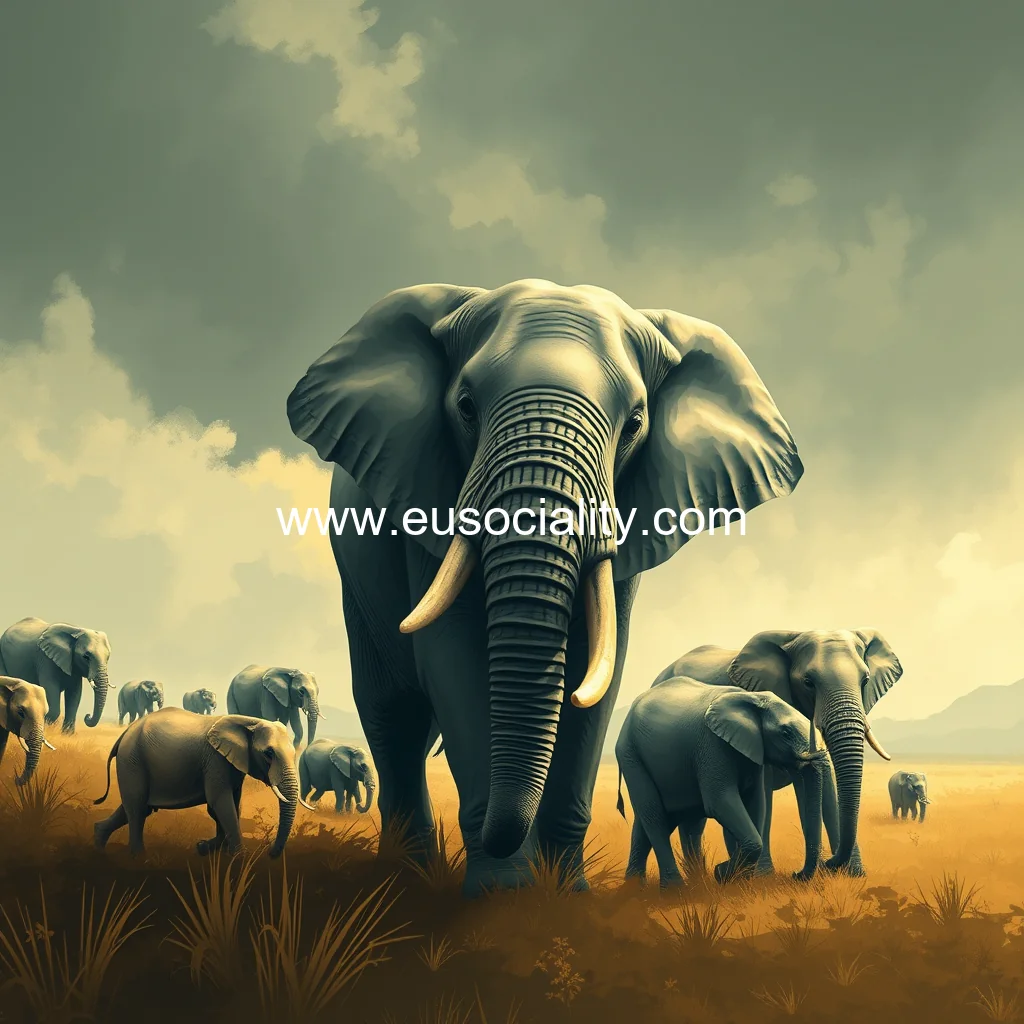
The elephants have been living in a fragmented landscape, with limited access to resources and habitat. This has led to a decline in their overall health and well-being.
The Impact of Human Disturbance on Elephant Societies
Human disturbance can have a profound impact on elephant societies, leading to a decline in their overall health and well-being. In Vietnam, the decline of the wild elephant population after the wars has resulted in the formation of smaller, fragmented groups.
Understanding Elephant Behavior
Elephants are known for their complex social structures and emotional intelligence. They live in large matriarchal herds, led by the oldest female, and have been observed displaying empathy, cooperation, and self-awareness. These traits are rare in the animal kingdom and are a testament to the intelligence and emotional depth of elephants.
Factors Influencing Elephant Behavior
Several factors can influence how elephants behave towards people. These include:
The Impact of Human Disturbance
Human disturbance can have a significant impact on elephant behavior, leading to increased aggression and stress. When elephants are subjected to frequent human disturbance, they may become habituated to humans and lose their fear of them.
These groups are usually formed by females who are closely related, such as sisters, mothers and daughters, or aunts and nieces. These groups are often characterized by a strong sense of cooperation and mutual support among members.
The Social Structure of African Bush Elephants
The social structure of African bush elephants is complex and multi-layered, with a clear hierarchy among females.
Complex social dynamics shape Asian elephant behavior and conservation efforts.
In contrast, adult males may be more solitary or form bachelor groups, but still occasionally associate with females to form a bond group.
The Complex Social Structure of Asian Elephants
The Asian elephant’s social structure is a fascinating and complex phenomenon that has garnered significant attention from researchers and conservationists alike. Unlike many other mammals, Asian elephants exhibit a unique and dynamic social hierarchy that is shaped by a variety of factors, including age, sex, and social experience.
Understanding the Social Levels
Asian elephants are typically organized into social levels, which are defined by the age and sex of the individuals within them. These levels are not strictly hierarchical, but rather fluid and dynamic, with individuals moving between levels as they age and gain experience. The lowest level is typically formed by juvenile males, who are often solitary or form bachelor groups. As males mature, they may join adult females in a family group, but may also remain solitary or form bachelor groups. Adult females, on the other hand, are often tightly knit and form a family group, which is typically led by the oldest female. Older females may also form a bond group, which is a smaller group of females that associate with each other but are not necessarily part of a larger family group.*
The Importance of Social Bonds
Social bonds are a crucial aspect of Asian elephant social structure, and play a vital role in the animals’ behavior, communication, and overall well-being.
Elephants’ social lives are shaped by group size and family bonds.
In contrast, Asian elephants have a more rigid social structure, with a clear hierarchy and a strong sense of family bonds.
The Social Structure of African and Asian Elephants
Group Size and Social Organisation
The social organisation of African and Asian elephants is shaped by their group sizes. In the African savanna, groups are typically smaller, ranging from 5 to 20 individuals. These smaller groups are often formed around a matriarchal figure, with females playing a central role in the social hierarchy. In contrast, Asian elephants form larger groups, often with 20 to 100 individuals or more. Key characteristics of African elephant groups: + Smaller group sizes + Matriarchal figure + Females play a central role in the social hierarchy
+ Larger group sizes + More rigid social structure + Strong sense of family bonds
The Impact of Group Size on Social Organisation
The difference in group sizes between African and Asian elephants has a significant impact on their social organisation. In African elephant groups, the smaller size allows for more fluid associations and a greater degree of flexibility in the social hierarchy.
Demography and Population Trends
The demographic characteristics of a species can provide valuable insights into its ecological and evolutionary history. In the context of our study, we examined the demographic trends of the species to understand how the population has changed over time. This involved analyzing the age structure, sex ratio, and reproductive rates of the population. Key demographic trends observed: + Age structure: The population is skewed towards younger individuals, with a high proportion of juveniles and sub-adults. + Sex ratio: The sex ratio is biased towards females, with a slight female bias in the population. + Reproductive rates: The reproductive rate is high, with a high number of offspring produced per female.
Socioecological Theory and Dominance Structure
Socioecological theory posits that the social structure of a species is shaped by its ecological environment.
I wouldn’t say there is a lot of work on the social organisation and behaviour of the Asian elephant even now. Long-term studies on the African savanna elephant have been going on for a long time. For instance, in Amboseli (in Kenya), long-term monitoring has been going on since the 1970s, and in Samburu since the 1990s. There has been long-term elephant monitoring in Uda Walawe, Sri Lanka since the 2000s. It is important to study different animal societies to understand sociality and find out if there are general rules that explain social organisation. We do not have very many studies on the social behaviour of different species in the country. There’s a lot of interest in birds and herpetology in the country nowadays, but we tend to be very tiger-centric when it comes to mammals. There is not a lot of work done on herbivores, in general.
Understanding Elephant Society
Elephants are highly social creatures that live in complex societies with a strict hierarchy. They have a matriarchal system, where the oldest and wisest female leads the herd. This matriarchal system is crucial in maintaining social order and ensuring the survival of the herd. The matriarchal system is based on a complex network of relationships and alliances between the females in the herd. The females in the elephant society are known for their exceptional memory and ability to communicate with each other through a variety of vocalizations and body language. The males in the elephant society play a crucial role in protecting the herd and its territory from external threats.
Human-Elephant Conflict
Human-elephant conflict (HEC) is a significant issue in many parts of the world, particularly in Asia. The conflict arises from the encroachment of human settlements and agriculture into elephant habitats, leading to the destruction of their natural habitats and the loss of their food sources. The main causes of HEC include: + Habitat loss and fragmentation due to deforestation and urbanization.
But, in reality, the dam has created a new bottleneck, and the resource is now more concentrated in one place, leading to more competition and conflict.
The Socioecological Theory of Resource Competition
The socioecological theory of resource competition is a widely accepted concept in ecology that explains how competition for resources affects the behavior and ecology of animals. This theory suggests that when resources are abundant and dispersed, animals are less likely to engage in aggressive behavior. However, when resources become concentrated in one place, competition increases, and animals may resort to aggressive behavior to obtain the resource.
Key Principles of the Socioecological Theory
The Impact of Human Activities on Resource Competition
Human activities, such as dam construction, can have a significant impact on resource competition. When a dam is built, it can create a new bottleneck, leading to increased competition and conflict over resources. This can have far-reaching consequences, including:
Many researchers rely on remote sensing and machine learning algorithms to analyze data, but this approach has its limitations.
The Importance of Field Research
Field research is essential for understanding wild animals and their behavior. By being in the field, researchers can collect data that is more accurate and reliable than what can be obtained through remote sensing and machine learning algorithms. Here are some reasons why field research is important:
The Limitations of Remote Sensing and Machine Learning
While remote sensing and machine learning algorithms can provide valuable insights into animal behavior and ecology, they have several limitations.
For instance, in the field of medicine, AI can be used to analyze medical images such as X-rays and MRIs to help doctors diagnose diseases more accurately and quickly.
The Power of AI in Medicine
AI has revolutionized the field of medicine in numerous ways, transforming the way doctors diagnose, treat, and prevent diseases.