The Hive Forecast Kit
The Eusociality method for turning one inspection into a three-week forecast: bees counted honestly, brood read as a clock, and every decision made for the colony you are about to have
Our Honeybee Hive Population Estimator counts the bees and the sealed brood in a hive and stops there; its own FAQ calls sealed brood the colony's near future and gives it no date. Our Colony Growth Calculator projects a colony forward but asks you to guess the queen's laying rate. Neither says what the colony in front of you will be in three weeks, which is what adding a box, making a split or buying a queen depends on. This kit joins them on one textbook fact: a worker cell stays sealed for 12 days, so sealed brood divided by 12 is the bees emerging each day, and the laying rate already measured. In the worked example, 18,594 sealed cells is 1,549.5 bees a day, and 17,314 bees today forecast to 34,977 in three weeks. Counted the quick way, frames with any brood, the same hive implies a queen laying 3,967 eggs a day, about twice the commonly quoted peak: the kit shows how to tell a counting error from a remarkable queen. The forecast then times the next box, tests a split on its weakest day (a three-frame nuc falls to 3.3 frames on day 46 waiting for its queen), and reads a brood break before you buy a queen. Every figure is computed by our calculators; the example hive, lifespans and thresholds are examples, and rules of thumb are called rules of thumb. The kit names no treatment, product, dose or schedule for mites or disease: hive-health questions go to your local beekeeping association or bee inspector. It carries the sting and anaphylaxis, protective gear and registration lines. Included: 7 steps, printable count sheet, forecast worksheet and split planner, reference tables, a bonus page on Hamilton's rule and worker policing in a real hive, and a personalised sheet worked from the numbers you enter in our calculators.
Look inside
Two full pages from the kit, exactly as printed. Click either to read it at full size before you decide.
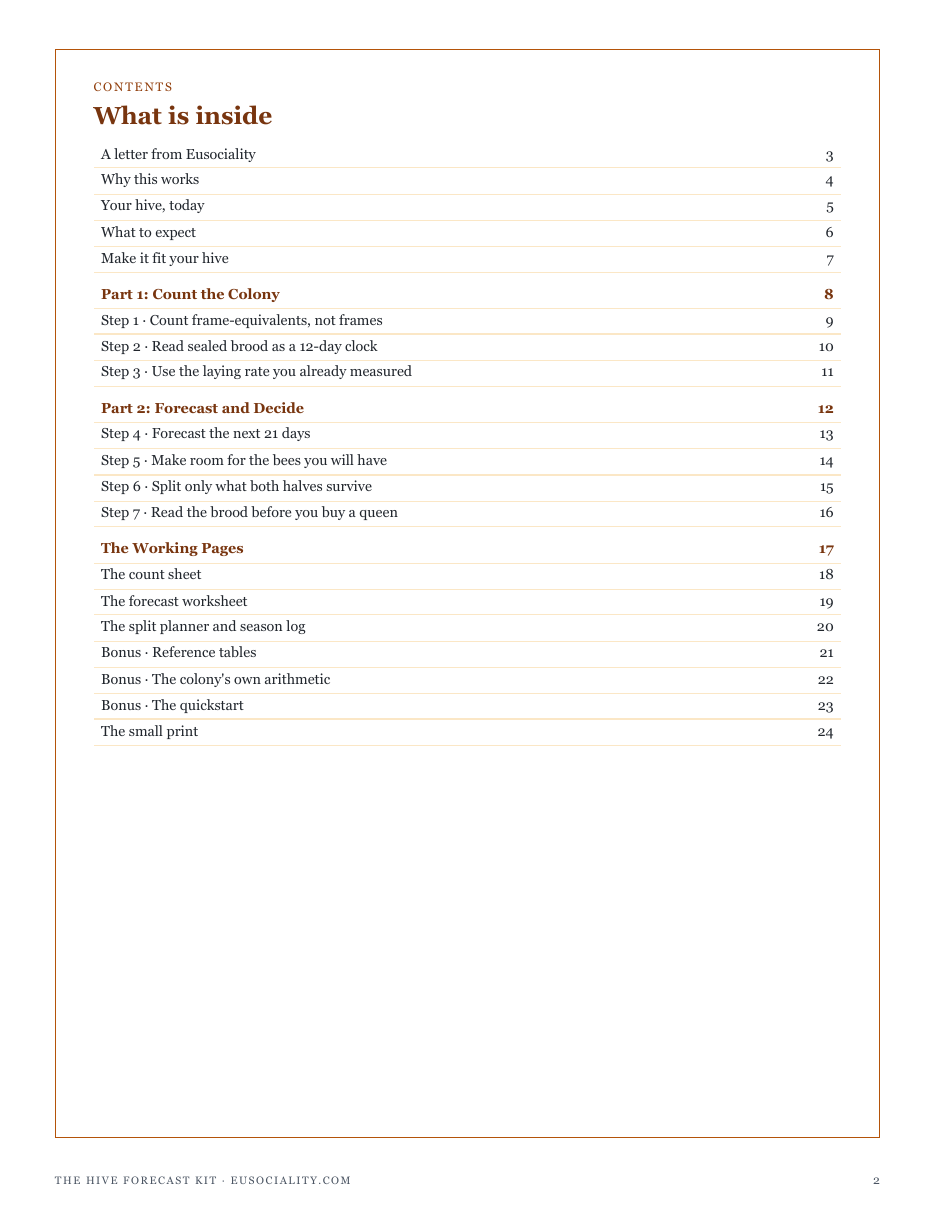
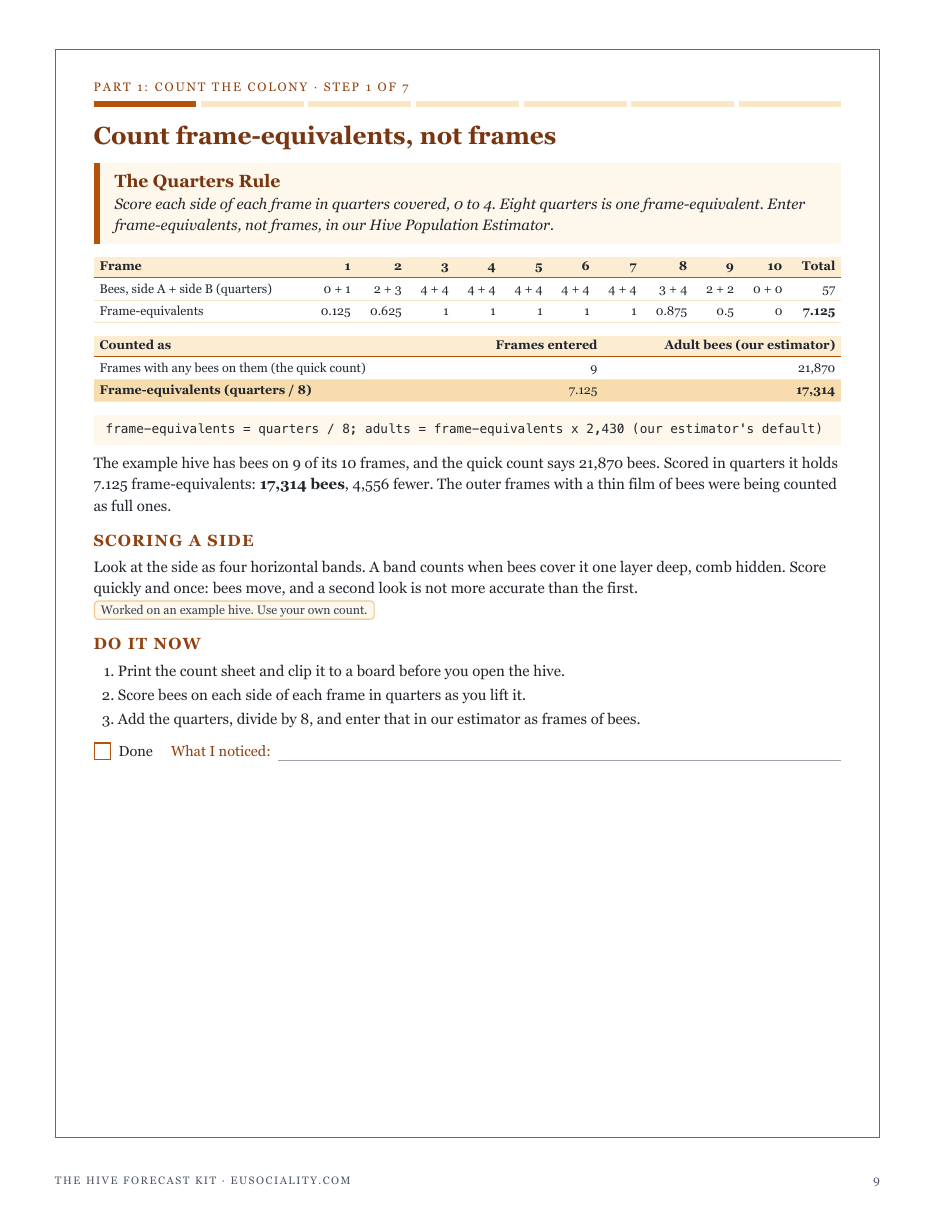
What is in it
- The Quarters Rule: bees scored in quarters of each frame side and entered as frame-equivalents, not frames
- The Divide by Twelve Rule: sealed brood as a 12-day clock, with a check against the commonly quoted peak laying rate
- The Two Paces Rule: open brood against sealed brood, the queen's measured pace entered in the Colony Growth Calculator
- The Brood In the Box Rule: the 21-day forecast at three lifespans on the site's own growth model
- The Room Ahead Rule: the day the forecast crosses the room trigger, and the box staged before it
- The Weakest Day Rule: a split judged on each half's weakest day, the day before its first new worker
- The Brood Calendar Rule: brood stages and the swarm calendar read before a queen is bought
- Printable working pages: a frame-by-frame count sheet, a forecast worksheet, and a split planner with a season log
- Reference tables, the colony's own arithmetic (Hamilton's rule, relatedness and worker policing), and a quickstart
- A personalised sheet worked from the numbers you enter in our calculators
- ✓ 24 printable pages
- ✓ 10 sections, worksheets and templates
- ✓ A second PDF worked out from the numbers you enter
- ✓ No account needed, just an email address
- ✓ Instant download; link valid 7 days
Price includes any taxes. Sold by GrabURL, who handle checkout and support. The charge appears on your statement as GrabURL.
The kit picks up where the free Honeybee Hive Population Estimatorleaves off. The estimator counts today's bees and sealed brood; the kit scores each frame side in quarters so the count is honest, divides sealed brood by twelve (a worker cell is sealed for 12 days) to get the bees emerging each day, checks that figure against the commonly quoted peak for a queen, and feeds it to the Colony Growth Calculator in place of a guessed laying rate. The forecast then decides when to add room, whether a split survives its weakest day, and whether a colony with no eggs needs a queen or just a few more days. A bonus page runs the Kin Selection Calculator on a real hive, with the haplodiploid values from the Relatedness Calculator. Safety comes with it: a veil every time, prescribed epinephrine carried if you are allergic to stings and emergency care for any trouble breathing, and your local rules on registering hives. The kit names no treatment, product, dose or schedule for mites or disease: hive-health questions go to your local beekeeping association or bee inspector. The worked figures are examples; your hive is yours to count.